Become a Founding MemberLearn More
Cover of the NexGen POTS & Ehlers-Danlos Protocol — Individual Protocol Library, by Jason Johns
Individual Protocol · Nervous system · Available now

The POTS & Ehlers-Danlos Protocol.

Fill the tank. Compress what pools. Train lying down until the heart has grown. Protect the joints. Thirty-four pages, evidence-tiered and written as a “what I would do if I were you”: the 10-minute stand test, the labs and autonomic testing to request, the fluid, salt and compression numbers, the recumbent-to-upright training progression adapted for hypermobile joints, the mast-cell, gut and sleep crossover, the physician conversation with trial doses, and a 12-week chart so you know whether any of it is working.

Any three protocols · $119

Unlocked in the NexGen Protocol app the moment payment clears. The download link also lands on your confirmation page. Written for men and women, every decade.

34pages, letter size
62references, each checked against PubMed
12weeks in three phases
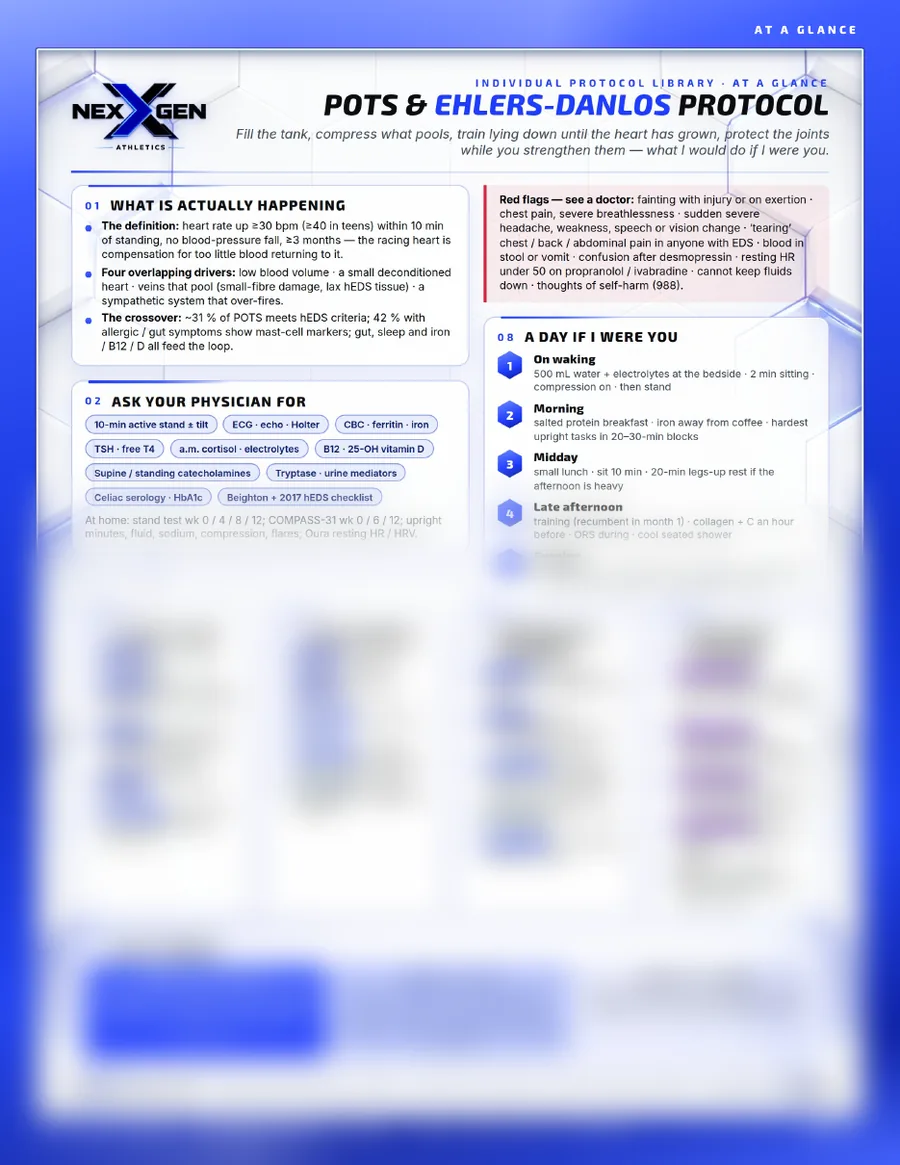
1infographic for the mirror or the fridge

A stand-alone edition that goes above and beyond what is in the Handbook of Health: PDF, one-page infographic, A–Z product index and a printable tracking chart. Educational information from an executive health coach, not medical advice.

Who it is written for
  • A heart that races when you stand, legs that pool, a head that empties, and fatigue and brain fog that nobody can explain
  • Joints that bend too far, dislocate or ache, and skin that bruises or scars easily — hypermobile EDS or hypermobility spectrum disorder, diagnosed or suspected
  • Flushing, hives, a reactive gut or food reactions riding along with the dysautonomia
  • Anyone who wants to walk into the cardiology or autonomic appointment with four weeks of stand-test numbers and the right questions written down
Read the red-flag page first if
  • Fainting with injury or during exertion, or a collapse with chest pain, severe breathlessness or palpitations that do not settle
  • Sudden severe headache, new weakness, slurred speech, vision loss, or a tearing chest, back or abdominal pain
  • You take fludrocortisone, midodrine, propranolol, ivabradine or desmopressin, or have hypertension, heart failure or kidney disease: the salt target and the interactions table are written for you
  • You are pregnant or planning a pregnancy — most medications change and the protocol says which
What’s inside

Thirteen sections. One tank, one pump, one set of joints.

A lower standing heart rate is the visible scoreboard; a fuller tank, a stronger heart, less pooling and joints that stay where they belong are the actual goal. The protocol spends as much time on your fluid and salt numbers, your compression and your recumbent training as it does on medication, because that is where the consensus guidelines and the trials say the leverage is.

Understand it

  1. Read this first — how to use the protocol
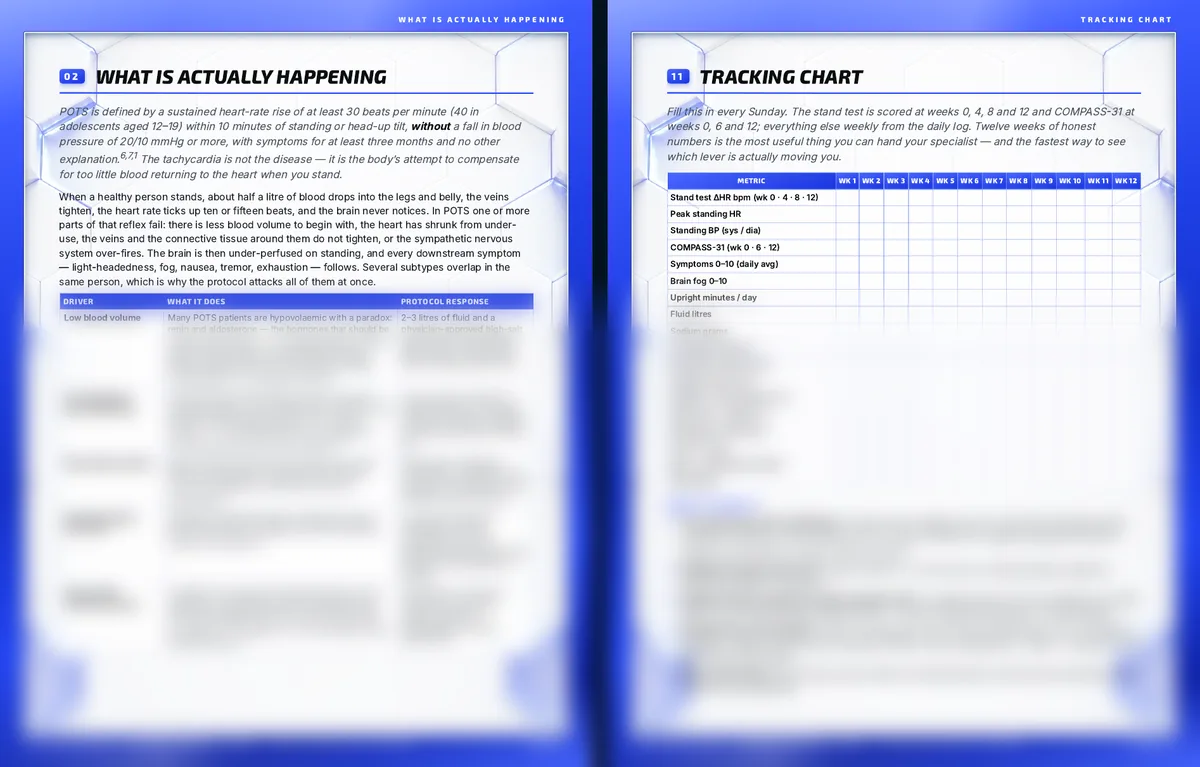
  2. What is actually happening: the heart-rate criteria, the subtypes (low volume, neuropathic, hyperadrenergic, deconditioned), the Ehlers-Danlos overlap, mast cells, the root-cause table
  3. Labs & autonomic testing to request: the 10-minute stand test done properly, tilt and autonomic testing, the mimics to rule out, ferritin, B12, vitamin D, thyroid, the celiac screen, the Beighton score and the 2017 hEDS checklist, COMPASS-31

Change it

  1. Fluids, salt & food — the numbers: 2–3 litres front-loaded, the bedside bolus, the physician-set salt target, smaller lower-carbohydrate meals, caffeine and alcohol
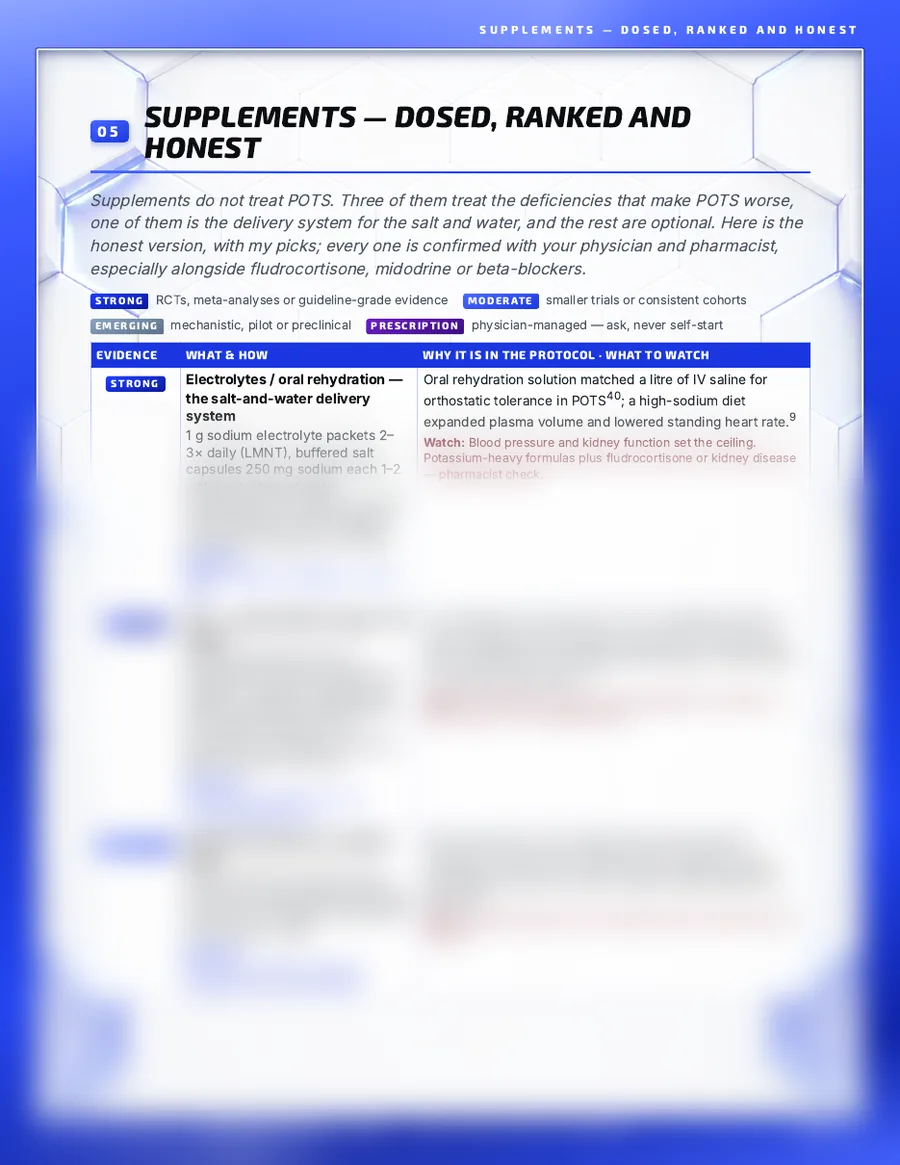
  2. Supplements — dosed, ranked and honest: electrolytes, iron, vitamin D, B12, magnesium, collagen with vitamin C, liposomal quercetin, targeted probiotics, and the honest read on the rest
  3. Compression, training & joint protection: abdominal binders and waist-high compression, the Levine-style recumbent-to-upright progression, hypermobility adaptations, isometric tendon loading, proprioception, counter-pressure manoeuvres
  4. Sleep, heat, gut, mast cells & pacing: head-of-bed elevation, cooling, the four-week low-histamine trial, the upright budget

Decide it

  1. Physician-managed options worth asking about, with trial doses: fludrocortisone, midodrine, low-dose propranolol, ivabradine, pyridostigmine, the H1 + H2 trial, desmopressin — and an honest read on IVIG
  2. What I would do if I were you — the 12-week protocol in three phases
  3. Red flags — when to see a doctor, plus the interactions table and the questions I would ask at the appointment

Track it

  1. The 12-week tracking chart — the stand test at weeks 0, 4, 8 and 12, COMPASS-31, fluids, sodium and upright minutes
  2. Preferred products & A–Z index
  3. References & disclaimer — 62 citations, each one checked
The 12 weeks

Fill the tank. Grow the heart. Then stand up.

The order matters. Phase 1 fills the tank and protects the joints, Phase 2 grows the heart and brings in the physician, Phase 3 moves you upright and measures what moved.

Phase 1Weeks 1–2

Foundation

Book the cardiology or autonomic appointment, the morning blood draw and a physiotherapist with hypermobility experience. Baseline 10-minute stand test, COMPASS-31, Beighton score, resting heart rate. Two to three litres front-loaded, 500 mL with electrolytes at the bedside before standing, the physician-set salt target, a bolus before any long stand. An abdominal binder or high-waisted compression from the moment you stand. Recumbent sessions three times a week, seated strength twice, ten minutes of proprioception daily, the counter-pressure manoeuvres learned. Smaller, salted, lower-carbohydrate meals. Electrolytes; iron, vitamin D and B12 as the labs dictate. Head of bed raised, the upright budget in blocks, sit to shower. Log everything.

Phase 2Weeks 3–8

Build

Week 3: the physician visit with the stand-test numbers, the labs and this document — fludrocortisone or midodrine for the pooling picture, low-dose propranolol or ivabradine for the tachycardia-dominant picture, pyridostigmine or an H1 + H2 trial where the log points to them; one change, then four weeks. Collagen with vitamin C before training, isometric tendon holds, four sessions a week with one upright-bike finisher. Week 4: repeat the stand test and adjust the salt target. Week 5: the low-histamine trial and quercetin only if the mast-cell picture is present; a probiotic only if the gut dominates. Week 6: COMPASS-31 — if the stand test has not improved by 5–10 bpm, the medication conversation moves to the second agent and the training is audited.

Phase 3Weeks 9–12

Consolidate

Training goes upright: two upright and two recumbent sessions, a short walk after one of them, standing strength to a box or with support. Week 12: the stand test, COMPASS-31, the labs that were abnormal (and potassium or sodium if a medication demands it), home blood pressure — side by side with week 0. Keep what moved: compression and training stay for life, medications continue under the prescriber’s monitoring, supplements that did nothing come out. Re-challenge the low-histamine foods one at a time. From month four: walking and jogging intervals, three sessions a week indefinitely, and the stand test once a month as the early-warning system.

How it is built

Tiered, dosed, and honest about the gaps

Every intervention is graded Strong, Moderate, Emerging or Prescription on the human evidence behind it, with the dose, the timing, the harm worth knowing and — where the Handbook of Health names a brand — the exact product I would buy. Where the evidence is thin (most supplements, IVIG, vagus-nerve stimulation) the protocol says so instead of selling you on it.

Coach, not clinician

Built to make your cardiologist’s or neurologist’s job easier

I am an executive health coach, not your physician. The protocol does not replace your prescriptions; it organizes everything around them — the labs to request, the questions to ask, the options to raise (from salt and compression to fludrocortisone, midodrine, ivabradine and the mast-cell trial), and the interactions a pharmacist would flag — so the appointment is productive and the time between appointments is not wasted.

Delivery

In the app in seconds, yours to keep

Pay once. The protocol is added to your account and appears under Protocols → My protocol library in the NexGen Protocol app, with a fresh download link whenever you need one. Print the tracking chart, put the infographic on the mirror, and bring the PDF to your next appointment. Weekly check-in clients: bring it to the next call and we calibrate it together.

Questions

Before you buy

Is this medical advice?

No. The protocol is educational information from an executive health coach, written as “what I would do if I were you.” It is not a diagnosis, a prescription or a treatment plan. Share it with your physician, especially if you are pregnant, breastfeeding, on prescription medication or managing another condition, and stop anything that produces a new symptom.

I already take midodrine or a beta-blocker. Is there anything in here for me?

Yes — arguably more. Medication works best on a full tank: the fluid, salt, compression and recumbent-training sections are what the consensus statements put first, and they are the part most people under-do. The stand-test and COMPASS-31 tracking give you and your physician a cleaner read on whether the drug is doing its job and when a second agent is worth discussing. Nothing in the protocol asks you to stop or change a prescription.

How is it delivered?

The moment your payment clears, the protocol is added to your account. Sign in to the NexGen Protocol app (on the site at nexgenathletic.com/app or the Android download) and open Protocols → My protocol library; the confirmation page also shows a download link. It is a 34-page PDF, letter size, with the one-page infographic on page two.

I already own the Handbook of Health. What does this add?

The Handbook is my whole system in one book, and it has no chapter on POTS or Ehlers-Danlos. This edition goes above and beyond it: thirty-four pages on this one pattern, with the 10-minute stand test, the labs and autonomic testing, the fluid, salt and compression numbers, the recumbent-to-upright training progression adapted for hypermobile joints, the mast-cell, gut and sleep crossover, the physician conversation, a 12-week plan with a tracking chart, and 62 checked references. Where the Handbook names a product I use, the same pick appears here.

What about the other Individual Protocols?

Every protocol in the library is $49, or any three for $119. The stand-alone editions, like this one, are written to go above and beyond what is in the Handbook of Health. The protocols still sold as chapter editions are being rebuilt the same way, one at a time, and anyone who buys a chapter edition receives the stand-alone edition free when it ships. See the library.

Refunds?

Digital products are non-refundable once delivered. If the file will not open or the link has expired, email supplementgraveyard@gmail.com and I will fix it the same day.


Your copy

Fill the tank. Compress what pools. Train lying down.

Twelve weeks, in order, with the numbers, the products and the timing spelled out.

Rather have it set up in your home? · $499